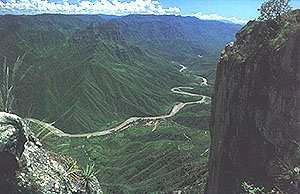
Physical Depths of the Canyons Urique Canyon 6136 feet Sinforosa Canyon 6002 feet Batopilas Canyon 5904 feet CandameñaCanyon 5775 feet Guaynopa Canyon 5113 feet Grand Canyon 4674 feet This graph illustrates the physical depth of the canyons: the largest in Mexico is the Copper Canyon and the deepest is the Urique Canyon. There are three rivers that drain the Sierra Madre Tarahumara, those are: the Rio Urique, Rio Batopilas, and Rio Verde. The largest is the Rio Verde and the most remote and difficult to reach. The geology of the canyon is primarily hard igneous strata with composition of Rhiolitic and Andesitic. This exceptionally hard stone is tremendously resistant to erosion.
The Copper Canyon is truly one of the Western Hemisphere's great scenic and cultural journeys, the Sierra Tarahumara (Copper Canyon) belongs on the wish list of most every traveler. It is fast becoming Mexico's most popular "soft-adventure" attraction while also catering to hardcore backpackers, day hikers, mountain bikers, bird watchers, historians, and naturalists.
The name, "Copper Canyon" is used as a general reference to the Canyons. A more proper name might be "Sierra Tarahumara", since the Copper Canyon (Barranca del Cobre in Spanish) is but one of six massive gorges in the area covering 64,000 sq. kms (25,000 sq. miles). Also of note is the fact that copper was never mined in great quantities here. The term refers to the copper/green colored lichen that clings to the canyon walls. Furthermore, a main draw to the region is the rich indigenous Tarahumara culture. This canyon system is four times larger than the Grand Canyon in the United States. Four of its six canyons are deeper than the Grand - some by over 1,000 feet.
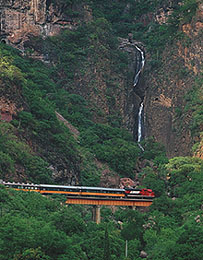
The Chihuahua al Pacifico Railroad carries riders from sea level to over 2,400 meters (8,000 feet) when traveling west from the agricultural city of Los Mochis, through coastal plains, up and over the Sierra Madre mountain range before descending to the city of Chihuahua 655 kms (393 miles) away. Along with the many bridges and tunnels which are crossed, there's even a 360 degree loop over itself at Km. 592. The region's geological splendor is equally remarkable. The Sierra Tarahumara is in fact a maze of 200 gorges which combine to form a series of six massive, interconnected canyons, or barrancas.
An incredible variety of ecosystems further distinguish the region. Highlands are home to snow-covered mountain peaks, sparkling lakes, and enormous stands of old-growth Poderosa pine and oak. The area's plunging gorges sprout wild rives, towering waterfalls and sub-tropical forests. Semi-arid coastal plains to the west support large sugar cane and rich vegetable farms, while valleys to the eastern (Chihuahua) region are home to peach and apple orchards and vast grasslands.
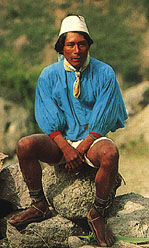
Wildlife is equally varied. 290 species migratory and indigenous birds, several large mammal species (bear, deer,large cats), and numerous reptiles (87 species) inhabit the area. Complimenting the area's awesome natural attractions is the equally interested Tarahumara (Raramuri, as they called themselves) Indian culture. These semi-nomadic people number around 50,000, many are predominately cliff and cave dwellers eking out a meager substance from simple farming, ranching, and handicrafts. Men are noted for their remarkable running ability, competing in grueling races that stretch non-stop for over 100 miles at times.