|
History of the
Rathaus
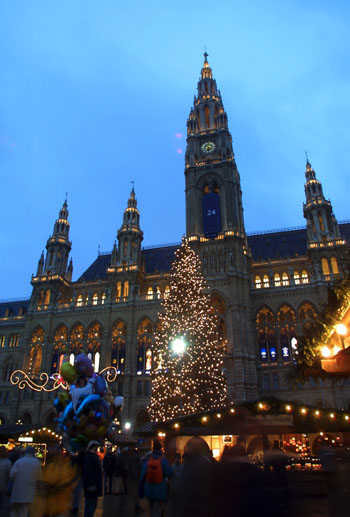
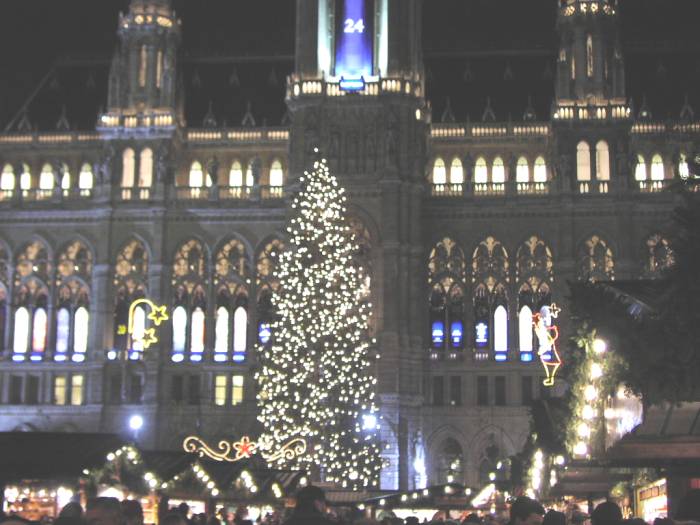
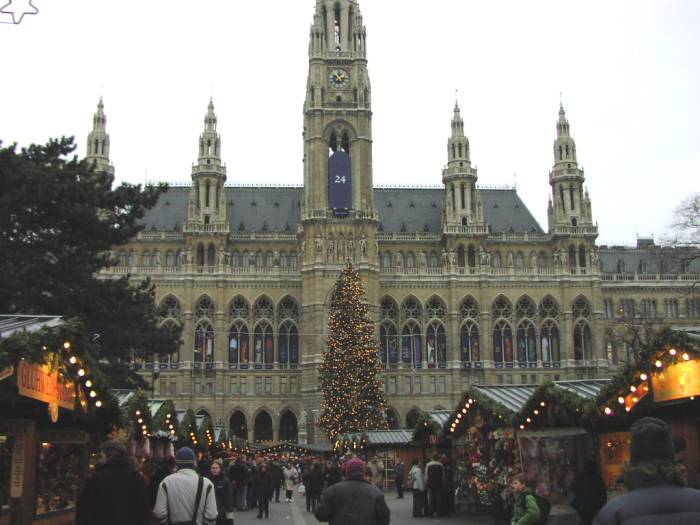
Friedrich von Schmidt, who had been the architect of the
Cathedral of Cologne, designed and built Vienna's City Hall, the most
important secular building in the neo-Gothic style in the city, between
1872 and 1883. The tower measures 321 feet, not including the "Iron
Knight of City Hall" (Eiserner Rathausmann) who measures almost 20
feet to the top of his pennant. This knight on top of the tower has become
one of the symbols of Vienna.
The City Hall is the seat of the mayor and governor of Vienna ( with
Vienna being both a city and a state since 1922, these functions are
combined in one person ), of the City Council and of the Assembly.
It also houses the Municipal and State Libraries and Archives which hold
many key documents of Vienna's history and a large collection of local
memorabilia.
On both sides of the approach from the Ring ( closed to motor vehicles ),
statues honor personalities who left their mark on the history of the
city.
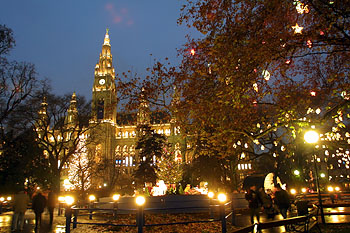
The Park of City Hall (Rathauspark) is a very attractively laid-out garden
with two fountains and several interesting monuments, among them the
memorial to the painter F. G. Waldmüller and the statues of two great
composers of waltzes, Johann Strauss and Joseph Lanner. Facing the
Burgtheater across the Ring are monuments to President Theodor Körner
(1873-1957) and Mayor Karl Seitz (1869-1950).
Off the spacious Arkadenhof (Arcade Courtyard) and also accessible from
the back of the complex is the Stadtinformation (City Information Office),
which is not a tourist information center but a referral office for
citizens and a source of information and statistics, on the city, its
administration, its operations and its public services. This is also the
starting point for guided tours through City Hall.
Vienna home page
|