|
St. Patrick
While information about St Patrick’s early life is
quite sparse, it is believed that he was born sometime between 370 and 380 in
the north of Britain. His father was a deacon and his uncle a presbyter. While
living in a place named Bannaven Taburniae at the age of sixteen, he was taken
captive and brought to Antrim to work as a slave. After escaping from captivity
he made his way to Gaul and later became a bishop. He returned to Ireland around
432 as a missionary after seeing a vision of Irish people calling upon him to
return. There is no contemporary reference to a visit to Dublin; the first
evidence appears in an eleventh-century homily in the Leabhar Breac.
However, St Patrick founded churches in Meath, Wicklow and Kildare, so a visit
to Dublin is very likely to have occured. In 445 he founded the See of
Armagh. He died in Saul on 17 March 461. Two of his writings survive; his Confession
and a letter to a British chieftain named Coroticus. A hymn called a Lorica
or Breastplate is also traditionally attributed to him. St
Patrick’s life is depicted in the West Window of the cathedral.
Top of Page
Collegiate Church
The English invasion under Henry II in the second half
of the twelfth-century resulted in significant reforms within the Church in
Ireland. In 1191 John Comyn, the first Anglo-Norman Archbishop of Dublin, raised
the little church of St Patrick's on the island to the status of a
collegiate church; that is, a church served by a large body of clergy devoted
equally to worship and learning. Part of his motivation lay in Norman dislike
for monastic orders. Perhaps more importantly, by building his own palace
and church outside the City walls on his own territory Comyn was no longer
subject to the jurisdiction of the city provosts. He gave the income of a number
of his parishes or prebends to support the clergy and some of the
prebends still bear the names of these parishes to this day. Comyn's charter of
1191 was confirmed by a bull of Pope Celestine III in the same year. It is
believed that the baptistery at the entrance to the cathedral is the only
surviving part of Comyn's church. Top
of Page
Why are there two Cathedral's in Dublin?
It is not known precisely when
St Patrick's was elevated to cathedral status. It seems possible that
this occurred during the episcopacy of John Comyn as Henry of London,
his successor, was elected by both the chapters of Christ Church
and St Patrick's and this election was recognised by Pope Innocent
III. The existence of two cathedrals in one city was entirely without
precedent and it would seem that it was originally intended that St
Patrick's, a secular cathedral, would replace Christ Church, the
regular cathedral. This was obviously resisted by Christ Church
resulting in the unusual situation of two cathedrals, each possessing
the rights of cathedral of the diocese. With the disestablishment of
the Church of Ireland in 1870, St Patrick's became the national
cathedral with canonical representation in the chapter from every
diocese in Ireland, while Christ Church became cathedral for the
united dioceses of Dublin, Glendalough and Kildare with Kildare ceded
to Meath in 1976. Top
of Page
|
The present building
John Comyn was succeeded as archbishop of Dublin by Henry of London in 1212,
a close friend of King John's and one of those responsible for the building of
Dublin Castle and the city walls. Henry was also one of the signatories of the Magna
Carta in 1215. Henry made several additions to the original cathedral
charter, creating the offices of dean, precentor, chancellor and treasurer, all
of which were to be drawn from the chapter. Also all deans were to be elected by
the chapter of canons from their own number. The cathedral chapter has retained
this right to the present day.
Henry is also responsible for beginning the process of rebuilding the
cathedral in the form in which we see it today. The first surviving
evidence of this is contained in an order from Henry III, dated 1225, allowing
preachers to travel throughout Ireland collecting alms. The construction of the
new church in the early English gothic style took about thirty years to
complete. The building was re-dedicated under his successor Archbishop Luke in
1254 and the Lady Chapel was added by Archbishop Fulk de Saundford in 1270. The
original tower and part of the west nave were destroyed by fire in 1362 but
between this year and 1370 they were replaced by Archbishop Minot.
Top of Page
The Reformation
Charter of Henry VIII
In the sixteenth-century the cathedral was to undergo many
changes as a result of the turbulent political changes in England. In 1537, by
an order of Thomas Cromwell, all images of saints in the niches of the choir
were demolished. The cathedral's revenues, estates and possessions were then
confiscated by Henry VIII and his commissioners: the dean of the day, Edward
Bassenet, imprisoned the chapter until they agreed to the hand-over.
The condition of the cathedral worsened in 1544 with the
collapse of the roof of the nave. In 1547 the Grammar School was established in
the vicar's hall, the palace of St Sepulchre was given to the Lord Deputy and
the minor canon's hall became an almshouse. The deanery was given to the
archbishop. Edward VI reduced the status of St Patrick's to that of a parish
church, designated part of the building for use as a court house and in 1559
ordered that the walls of the cathedral should be repainted and inscribed with
passages from the scriptures. In 1555 the charter of Philip and Mary restored
the cathedral's privileges and restoration of the fabric began. It is also
recorded that the first public clock put up in Dublin was erected in "St
Patrick's Steeple" in 1560.
In the first year of the reign of Elizabeth I, use of the Book
of Common Prayer was introduced. In what was quite a conservative revision, the
daily offices were reduced from seven to two—Matins and
Evensong, one for the morning and one for the evening. The aim of these services
was to ensure regular reading of scripture. The Psalter was to be read through
once a month, and the Bible to be read in its entirety—the
Old Testament once per year and the New Testament three times. There was also a
new emphasis on the preaching of the word which in the previous century had
become seriously neglected. For various reasons there was less emphasis on the
Eucharist and its celebration was for the most part confined to Sundays and Holy
days. Top
of Page
The Huguenots
In the sixteenth- and seventeenth-centuries the Huguenots
found themselves subject to periods of persecution. Large numbers were forced
into exile and took refuge in different parts of Europe with many settling in
various parts of Ireland. Here they exercised great influence on the economic
life of the country: the district around St Patrick's attracted those who were
engaged in the silk industry.
In Ireland the Huguenots found religious tolerance but
there was no church in which they could worship in their native tongue. To this
end the Earl of Ormonde and Viceroy of Ireland petitioned the Archbishop of
Dublin who suggested the use of St Patrick's cathedral. In 1666 the dean and
chapter of the cathedral made over the Lady Chapel for their use and it became
known as L'Eglise Française de St Patrick. The original lease was
dated 23rd December 1665 and was renewed from time to time until the
services ceased in 1816. The chapel was prepared for the use of the congregation
with the aid of a subscription and galleries were placed along the interior. The
first service was held on Sunday April 29 1666 in the presence of the Lord
Lieutenant and the Archbishops of Armagh and Dublin. The Prayer Book service was
read in French by M. Hierome, the new minister, who was chaplain to the Duke of
Ormonde. By 1816 the Huguenots had become absorbed into the general population
and use of the French language had ceased.
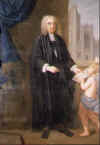
Jonathan Swift was born in Dublin in 1667. His father
died before he was born, so he was brought to England by his mother, where
he was brought up by aunts and uncles. He received his education at Kilkenny
College and entered Trinity College, Dublin in 1682. He spent some time as
secretary to Sir William Temple, a former diplomat and writer, at Moor Park in
Surrey and it was here that he met Esther Johnson, know as Stella in his
writings.. In 1694 he was ordained into the ministry of the Church of Ireland
and his first parish was Kilroot in county Antrim. He was appointed vicar of
Laracor in county Meath in 1699 and remained in this position for the rest of
his life. An altar table from this church can be seen in the cathedral. The
following year he was appointed to the prebendary of Dunlavin in St Patrick’s
cathedral giving him some standing in the church. During this period he managed
to secure for the Irish clergy remission of certain taxes on their incomes,
originally due to Rome, but which from the time of the reformation had been
retained by the crown. Despite this, his outspoken manner stood in the way of
preferment and instead of the bishopric he had hoped for, he was appointed dean
of St Patrick’s, a position which he held from 1713—1745.
Top of Page
Jonathan Swift
As dean, Swift proved himself to be
most conscientious both in his religious duties and also as custodian of
the building. He attended service in the cathedral every day and
established the custom of celebrating the Eucharist every Sunday; the
only church in Dublin at the time to have such a practice. He was
responsible for restoring several of the monuments in the cathedral and
was well known for his charity to the inhabitants of his liberty—he
built an Alms house for old women who were no longer able to maintain
themselves.
Swift's epitaph can be seen in the cathedral.
In translation it reads:
|
 |
Here is laid the
body of Jonathan Swift, Doctor of Divinity, Dean of this Cathedral
Church, where fierce indignation can no longer rend the heart. Go,
traveller, and imitate if you can this earnest and dedicated champion of
liberty. He died on the 19th day of October 1745 AD. Aged 78 years.
Top
of Page
|
The Knights of St. Patrick
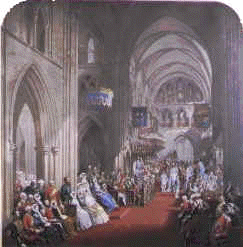 The Most Illustrious Order of St Patrick
was founded by King George III in 1783 as an honor for the more
influential peers in Ireland. It was to be similar in structure to the Order of
the Garter in England and the Scottish Order of the Thistle. The Lord Lieutenant
George Grenville Nugent Temple, later Marquis of Buckingham was the first Grand
Master and the Dean of St Patrick's was the Registrar. St Patrick's Cathedral
was the Chapel of the Order and the Great Hall in Dublin Castle, now known as St
Patrick's Hall, was the Chancery where Knights were normally installed and where
banquets were held on St Patrick's Day. The first installation took place in the
Cathedral on 17 March 1783. The Most Illustrious Order of St Patrick
was founded by King George III in 1783 as an honor for the more
influential peers in Ireland. It was to be similar in structure to the Order of
the Garter in England and the Scottish Order of the Thistle. The Lord Lieutenant
George Grenville Nugent Temple, later Marquis of Buckingham was the first Grand
Master and the Dean of St Patrick's was the Registrar. St Patrick's Cathedral
was the Chapel of the Order and the Great Hall in Dublin Castle, now known as St
Patrick's Hall, was the Chancery where Knights were normally installed and where
banquets were held on St Patrick's Day. The first installation took place in the
Cathedral on 17 March 1783.
To qualify for membership each Knight had
to be a "gentleman of blood without reproach and descended of three
descents of noblesse". Each Knight had to send to the cathedral his banner,
a symbolic sword, a symbolic helmet and crest and to arrange with the King of
Arms to have a hatchment made of his arms. These were to be placed on or above
the stall in the choir to which he was allotted, there to remain for his
lifetime. The present banners represent those of the knights in 1864 to which
were added those of the Prince of Wales (1868) and the Duke of Connaught (1869).
The last great ceremony held in the
St Patrick's was in 1868 when the Prince of Wales was invested as a knight. At
the disestablishment of the Church of Ireland in 1871, the Order was secularised
and the association with St Patrick's Cathedral ceased.
Top
of Page
Decay and Restoration
|
|
|
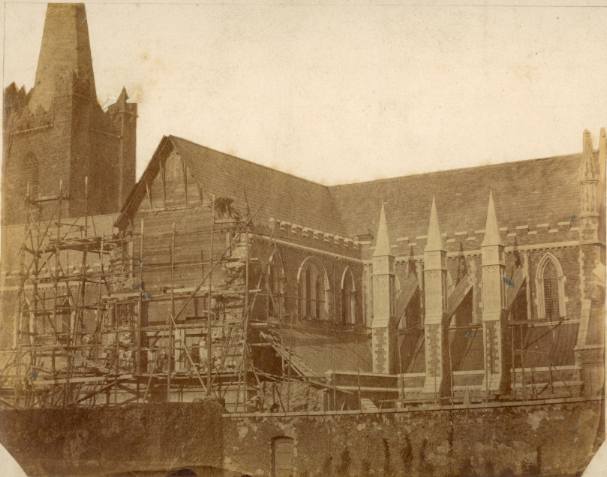
Photograph of the South Transept
c. 1863
|
Over the centuries the fabric of St Patrick's Cathedral
underwent a gradual decline. By the early seventeenth century the Lady Chapel
seems to have been in ruins, the arch at the east end of the choir was closed
off by a lath and plaster partition wall inscribed with the ten commandments and
the cathedral suffered regularly from flooding. Since the middle of the
fourteenth century the north transept of the building had been used as the
parish church of St Nicholas Without (the city). By the mid-seventeenth century
a series of galleries had been added to it to accommodate the large
congregation. After the restoration of the monarchy in 1660, repairs to the
building got underway. In 1668 the roof which was in danger of collapsing was
taken down, the new roof being completed by 1671, and the organ was also
removed. Buttresses were erected and the west window was replaced with a
perpendicular window. In the 1680's the choir was replaced and re-roofed.
However the cathedral continued to fall into disrepair
and in 1792 divine service was temporarily suspended as the south wall and the
nave roof were in such bad condition, the wall being two feet out of
perpendicular. A report from the cathedral architect in 1805 not only mentions
these problems but also shows that the north transept was in ruins and the south
transept was in a perilous condition. The only repairs which took place at this
time were to the nave roof which had until this time been held up by
scaffolding.
The first real attempt at a thorough restoration began
under the direction of Dean Pakenham (Dean of St Patrick's 1843 - 1864), though
this had soon to be abandoned, there being a scarcity of funds due to the famine
which occurred at this time. He restored the Lady Chapel, lowered the floor to
its original level and carried out several other repairs which temporarily kept
the building from collapsing. It was during his restoration that the medieval
tiles which are now situated in the Baptistery were discovered in St Paul's
Chapel. Top
of Page
Guinness Restoration
 In
1860 a complete restoration of the
cathedral commenced, funded by Sir Benjamin Lee Guinness. His restorations
included the rebuilding of the south wall, the addition of the south
porch and the replacement of the perpendicular west window with a three
light Early English window. Various screens and chambers including the choir
screen upon which the organ had been situated were removed, opening up the
entire cathedral space for the first time in centuries. In
1860 a complete restoration of the
cathedral commenced, funded by Sir Benjamin Lee Guinness. His restorations
included the rebuilding of the south wall, the addition of the south
porch and the replacement of the perpendicular west window with a three
light Early English window. Various screens and chambers including the choir
screen upon which the organ had been situated were removed, opening up the
entire cathedral space for the first time in centuries.
The cathedral which had been closed during
the restoration work was reopened on St Matthias Day 24 February 1865. The
opening service was attended by the primate, the Dean and Chapter from Armagh,
the Chapel Royal and Christ Church, the Archbishop of Dublin and the Lord
Lieutenant.
Lord Ardilaun and Lord Iveagh, sons of Sir
Benjamin, continued his work. Lord Iveagh was responsible for the restoration of
the choir, the refitting of the bell tower and the provision of the park among
other things. In 1902 Lord Iveagh presented the cathedral with a new organ built
by Henry Willis and Sons which was placed in a specially constructed chamber at
the triforium level on the north side of the building. A further restoration of
the building took place in 1972 and work has just started on sections of the
cathedral roof.
|