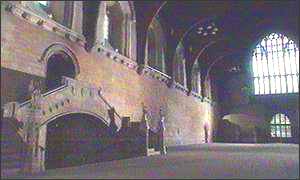
At first the Hall was an aisled building, with two rows of columns
supporting a lower, lighter and simpler roof, an arrangement which
continued for 300 years. Between 1394 and 1399, in the reign of Richard
II, the Hall was transformed, its Norman walls being heightened and
buttressed to enable them to carry the weight of a great new roof of
English oak, designed to cover the building in a single span, without the
need for supporting columns. This roof, seen today, is the greatest
surviving achievement of medieval English timberwork. It was the creation
of Hugh Herland, the King's master carpenter. It is constructed on the
cantilever or 'hammerbeam' principle, and is the earliest as well as the
most extensive roof of this type in existence. The roof lantern, now
glazed, was the large opening through which the smoke from the medieval
fires was expelled. The windows and the new stonework were by Henry Yevele,
the master mason. Since the roof was completed in 1399, it has been
repaired in 1819, in 1913 and again in 1945, after slight damage by
incendiary bombs during the war.
The derivation of judicial authority from the person of the King led to
the use of the Hall for holding the King's courts. By the 14th century the
north-west, south-east and south-west corners had become established
meeting places of Courts of Common Pleas, King's Bench and Chancery
respectively. (The normal use of the Hall for dispensing justice only came
to an end in 1882 when the Courts of Justice moved to the Strand.) The
remaining space within the Hall along the walls was occupied by shops and
stalls.
This general arrangement was from time to time interrupted for great
public and parliamentary occasions. Coronation banquets took place in the
Hall from at least 1170, the last being that of King George IV in 1821. In
the 20th century luncheons were also held here for representatives of
Commonwealth Parliaments on the occasion of the Coronation of the
Sovereign. The Hall has also witnessed many state trials and impeachments,
such as those of Sir Thomas More in 1535, of Guy Fawkes in 1606, and of
Charles I in 1649.
The Hall has continued to be used for such solemn ceremonial occasions
as the Lying-in-State of members of the Royal family, including King
George VI who lay in state for three days and four nights in 1952, and two
great commoners, William Gladstone and Winston Churchill.
The Hall has also been the setting for a number of parliamentary
occasions, notably the presentation of Addresses by both Houses of
Parliament to the Sovereign. Addresses were presented in 1965 to mark the
seventh centenary of the summoning, to the Hall, of the Parliament of
Simon de Montfort, and in 1977 to celebrate the 25th anniversary of the
accession to the Throne of Her Majesty The Queen. The London conferences
of the Commonwealth Parliamentary Association and of the
Inter-Parliamentary Union have been opened here by The Queen.