- Length: 107m
- Width of Nave: 24.3m
- Height of Ceiling: 22.5m
- Height of Central Tower: 46.3m
- Height of Front Towers & Spires:74.6m
St. Mary's Cathedral is the spiritual home of Sydney's Catholic community. It
is the seat of the Archbishop of Sydney, and stands on the site of the first
Catholic Chapel in Australia. Constructed in local sandstone, the Gothic
Revival style of its architecture is reminiscent of the great medieval
cathedrals of Europe. St Mary's is not only a great legacy from the past,
however: it is vital part of the present spiritual and cultural life of the city
and the nation. The Cathedral is dedicated to the Blessed Virgin Mary, under the
title of Immaculate Mother of God, Help of Christians.
What a Cathedral is
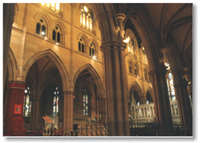 The
Catholic Church around the world is made up of particular Church communities,
led by a bishop. As chief pastor and teacher of his Church, the bishop has an
official chair, called a cathedra, in the main church building of his particular
community (called a diocese).
The
Catholic Church around the world is made up of particular Church communities,
led by a bishop. As chief pastor and teacher of his Church, the bishop has an
official chair, called a cathedra, in the main church building of his particular
community (called a diocese).
This church with the cathedra is called a Cathedral.
It is the place where the Church community gathers with their bishop for the
most significant feast-days and other important events. A Cathedral is not
necessarily a large Gothic building and not every large Gothic church is a
Cathedral!
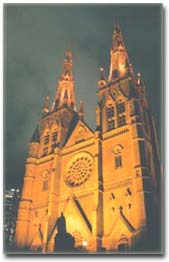 William
Wilkinson Wardell was commissioned by Archbishop Polding to design a new St.
Mary's following the fire of 1865 which ruined the original cathedral.
William
Wilkinson Wardell was commissioned by Archbishop Polding to design a new St.
Mary's following the fire of 1865 which ruined the original cathedral.
Wardell was born in 1823, and as an architect in
England had become an accomplished practitioner of the Gothic Revival style
championed by A.W.N. Pugin, and like Pugin, Wardell became a convert to
Catholicism.
He came to the Australian colonies in 1858, living in Melbourne. Wardell
designed several important buildings in Melbourne, including St. Patrick's
Cathedral. In Sydney, St. John's College within the University of Sydney stands
as further testimony to his skill. Polding wrote to Wardell, ``... And now for
the design itself of our new cathedral. I have little to say beyond this, that I
go to the architect of St. John's College of the University of Sydney to ask him
for something that shall again be an honour to himself and the Catholics of the
diocese. I leave all to you and your own inspiration in the matter. I will not
even say that your conception shall be restricted to the Gothic style of any
particular period. Any plan, any style, anything that is beautiful and grand, to
the extent of our power."(letter of 10 October, 1865).
Polding was not to be disappointed by Wardell, for the building he designed
is indeed ``beautiful and grand". Constructed of dressed Sydney sandstone,
St. Mary's stretches some 106m. (350 feet) in length, and the central tower
rises to 46m. (152 feet). When the intended spires are built, the Cathedral will
soar to 75m. (245 feet).
St. Mary's is designed principally in the Geometric Decorated style of Gothic
which first evolved around the 13th century. It is not a copy of a particular
medieval cathedral, but is a unique design, drawing on certain elements of its
medieval forbears. In keeping with many medieval English cathedrals, there is a
strong emphasis on the length-wise dimension of the building, while viewed from
the side it is more reminiscent of a typically French cathedral. Viewed from the
front facade, it is more reminiscent of a French cathedral, with twin towers
flanking a rose window.
The customary East - West orientation of cathedrals was abandoned by Wardell,
probably because the fall of the land together with the great length of the
building would have made such an orientation impractical. Instead of being at
the East end, therefore, the Sanctuary of St. Mary's is located at the North end
of the plan, with the main facade and principal entrance at the South end.
Even so, the slope of the land and an apparent error in the ``starting
point" of the building on the site necessitated the addition of a flight of
more than thirty steps to the front of the building by the architects, Hennessey
& Hennessey, who took responsibility for the completion of the Cathedral to
Wardell's design after his death in 1899.
One of the consequences of the North - South
orientation of St. Mary's is that for most of the day, the sun shines directly
through only the three windows at the Northern end, making the cathedral more
dark inside that one might expect. However, in the early morning the cathedral
is filled with rich, warm light as the sun beams through the amber glass of the
fourteen clerestory windows along the Eastern side. This effect is repeated with
even greater brilliance in the late afternoon, as the sun penetrates the Western
elevation of St. Mary's.
A visitor to St. Mary's will see many features on
the outside of the building: the flying buttresses of the chancel and nave; the
canopies and statues in the Northern gable, the text of the Ave Maria and other
invocations carved high up on the walls; the many carved saintly heads which
gaze benignly down, and, way up on the towers and turrets, the more menacing
figures of the gargoyles.
Moving inside the church through the main doors, the
eye is drawn forward, along the length of the Nave, toward the white pinnacles
of the High Altar Screen, and the rich colours of the Great North Window beyond.
The columns of the main arcade are of the same warm
sandstone as the exterior and interior walls, which has also been used in the
vaulted ceilings of the side aisles and chapels. The ceiling of the Chancel is
vaulted in timber, and the roof of the Nave is of double hammerbeam
construction. Looking up towards the ceilings, the visitor will notice many more
of the saintly heads first seen on the outside walls.
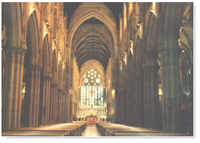 As
is usual in Gothic cathedrals, St. Mary's has three levels of arched openings
along its length: the high arches of the main arcade, the gallery-like openings
of the triforium, and the windows of the clerestory.
As
is usual in Gothic cathedrals, St. Mary's has three levels of arched openings
along its length: the high arches of the main arcade, the gallery-like openings
of the triforium, and the windows of the clerestory.
At intervals along the Nave walls, triple archways lead to the Confessional
rooms. Small columns of Moruya granite divide these openings. On the Eastern
side of the Nave, a larger archway forms the entrance to the Baptistery, with
its apse-like form and ornate ceiling. Stained glass windows pierce the walls of
the Nave, Transepts and Chancel.
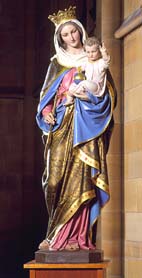 Our
Lady Help of Christians, in whose honour the Cathedral is dedicated. Under this
title, Mary is the Patroness of Australia. The statue was donated to the
Cathedral in the 19th century.
Our
Lady Help of Christians, in whose honour the Cathedral is dedicated. Under this
title, Mary is the Patroness of Australia. The statue was donated to the
Cathedral in the 19th century.

In
the Western Nave aisle, stairs lead down to the Crypt, remarkable for the beauty
of its floor of terrazzo mosaic. In vaults beneath the floor of the Crypt lie
the mortal remains of the deceased Archbishops of Sydney and pioneer priests
such as Fr. J.J. Therry, the founder of St. Mary's.
MAIN FEATURES
The Sanctuary
contains the original High Altar, the newer timber Main Altar, the Archbishop's
throne or cathedra, the Lectern for the proclamation of the Word of God.
Surrounding the Sanctuary are the Chapels, which are
dedicated to: The Sacred Heart; St. Joseph; The Blessed Virgin Mary (the Blessed
Sacrament is reserved in this chapel); St. Peter; The Irish Saints. The
Sanctuary, Chapels , and the aisles that join them, together form the Chancel.
Altars
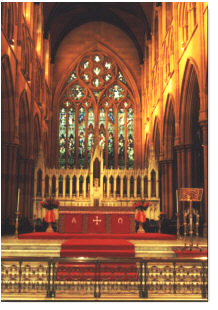 The
High Altar and screen, and the altars in the chapels of the Sacred Heart, St.
Joseph, Our Lady and St. Peter, were designed by Wardell and constructed of New
Zealand Oamaru stone. The altar in the Chapel of the Irish Saints is a later
addition designed and executed in Italy of marble. The High Altar also has
marble columns with carved alabaster capitals. A free standing timber altar,
usually draped with rich cloth frontals, was placed in the main sanctuary after
the liturgical reforms of the Second Vatican Council.
The
High Altar and screen, and the altars in the chapels of the Sacred Heart, St.
Joseph, Our Lady and St. Peter, were designed by Wardell and constructed of New
Zealand Oamaru stone. The altar in the Chapel of the Irish Saints is a later
addition designed and executed in Italy of marble. The High Altar also has
marble columns with carved alabaster capitals. A free standing timber altar,
usually draped with rich cloth frontals, was placed in the main sanctuary after
the liturgical reforms of the Second Vatican Council.
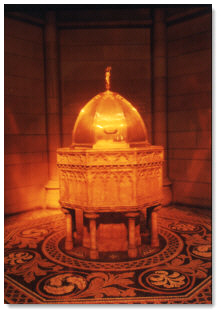 The
Font
The
Font
Located in a special chapel called the Baptistery, the baptismal Font is made
of ``Royal Sienna" marble carved in Sydney.
Floors
Mosaic floors are a feature of the main Sanctuary,
the Chapels, Baptistery and the Cathedral crypt. The brightly coloured floor of
the crypt is an outstanding example of terrazzo mosaic.
Stained Glass Windows
The stained-glass windows in the Cathedral were crafted in England, at the
Hardman studios of Birmingham, from 1881 onwards.
In the area of the sanctuary and transepts the
windows mostly depict the fifteen ``mysteries of the rosary", climaxing in
the Great North Window with the ``Coronation of the Blessed Virgin Mary".
There are also windows in the chapels with themes of the Sacred Heart; St
Joseph; St Peter; St Patrick & St Brendan; St Gregory sending St Augustine
to convert the English; and a memorial to Cardinal John Henry Newman.The
windows in the Nave mostly show scenes from the New Testament, and the first
four on each side also show notable moments in the history of the Church in
Sydney prior to completion of the Cathedral. The ``rose" windows depict, in
the West Transept, Adam with the prophets and patriarchs of the Old Testament;
in the East Transept, Christ with St John the Baptist, the Apostles and
Evangelists. The southern rose window shows St Peter and sixteen of the Popes.
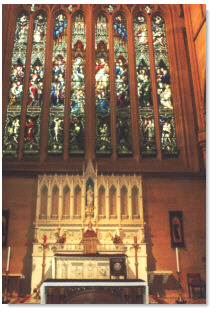 Stations
of the Cross
Stations
of the Cross
The fourteen large oil paintings of the Stations of the Cross were acquired
by Cardinal Moran in 1885 during a visit to Europe, and hung in the aisles near
the sanctuary prior to the extension of the Cathedral.
The Bells
The bells of St. Mary's hang in the central tower. These fourteen bells were
installed in 1986, replacing an earlier peal of eight bells transferred when the
central tower was completed in 1900 from the tower of the old cathedral, where
they had been hung in 1882. These in their turn had replaced the original bells
of St. Mary's, first hung in a wooden belfry near the old Cathedral in 1842. All
three peals of bells have come from the same foundry, now known as the
Whitechapel Foundry, in London.
The bells are rung manually in the English ``change-ringing" manner.
The Organs
Archbishop Polding acquired a fine organ for the first St. Mary's. Built by
Bevington & Son in London, with a case designed by A.W.N. Pugin, this 34
stop, 2 manual and pedal instrument was the largest in Australia when it arrived
in 1841. It was destroyed in the tragic cathedral fire of 1865. The first pipe
organ in the present Cathedral was built by C. J. Jackson of Sydney in 1874, had
26 stops, and was demolished in 1959. The organ in the gallery over the main
doors is by Whitehouse Bros. of Brisbane, dating from 1942. It is a 26 stop, 2
manual & pedal instrument.
The organ in the Chancel, whose pipes are in the triforium above the
sanctuary, is by R.W. Sharp of Sydney, and dates from 1960. It had long been
desired to provide organs well suited to the great size and diverse musical
needs of St. Mary's. In 1997, the Canadian organ builders, Orgues LeTourneau,
were commissioned to build a large new organ to be located in the West Transept.
This splendid 46 stop instrument was installed and blessed just prior to
Christmas, 1999.
The ``Pieta"
A Carrara Marble replica of Michelangelo's famous
statue was given to the Cathedral in 1971 by David Jones LTD and placed in the
West Transept.
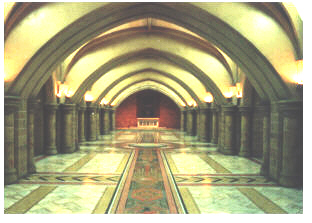 The
Crypt
The
Crypt
Located beneath the Nave, the crypt, last
resting-place of the deceased Archbishops of Sydney, is notable for the
beautiful terrazzo mosaic floor, depicting the story of the Creation, and
symbolic titles of the Blessed Virgin Mary.
Home page | Sydney
page 2


