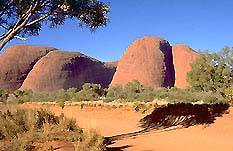
To the north of Uluru lie the 36 smaller monoliths known as Kata Tjuta (The Olgas). The highest of the monoliths is Mount Olga which rises to 546 meters. The Olgas are spread across an area of some 3500 hectares and the distance around the group is approximately 22 km. It is thought that Kata Tjuta may have once been one gigantic monolith many times the size of Uluru. Millions of years of erosion have reduced the single monolith to a series of smaller monoliths.
Although they are quite close to each other Uluru and Kata Tjuta have quite different geological and human histories. Where Uluru is a sedimentary rock which has been tilted nearly 85°, Kata Tjuta has only been tilted some 20°. They are made of a much coarser sediment and contain quite large pebbles of granite and basalt.
The name Kata Tjuta means 'head' and 'many' in the language of the traditional owners.
Artistically Kata Tjuta is noted for its engravings and its rock piles whereas Uluru is famous for its rock paintings. Both the engravings and the geometric rock piles are believed to have been created by the Spirit Ancestor during the Dreamtime.
 |
|
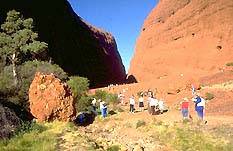
| Olga Gorge | People clambering over the rocks at Olga Gorge |