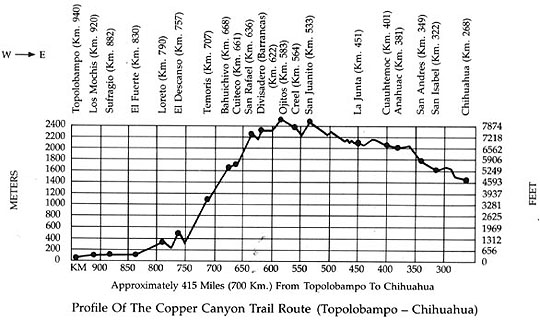
| The main reason
for suggesting this west-to-east route is better canyon viewing during
daylight hours. The line's most spectacular scenery is between Temoris
and Cerocahui, on the western flank of the Sierra Madre mountains. The
eastbound train travels this section during peak sunlight hours (10am-12
noon), while the train from Chihuahua may enter this area after sundown
(especially during the winter months).
There are two trains daily in each direction: Primera Especial
and Segunda Clase. Primera Clase is first class. Most first class
trains will have a restaurant and bar car, comfortable seats and
security. Segunda Clase is second class, and about half the price of
first class. It is only recommended as a last resort, as the cars will
be crowded and not well-tended, without a restaurant car, and is much
slower, thus you may not see the sights of the Canyons. The train trip
takes about 13 hours one way, 15-16 hours for second class.
 |
Backpackers, campers and explorers usually opt for the Creel
or Bahuichivo stations as departure points for treks into the Batopilas
and Urique
canyons. All four stations offer lodging, some facilities, and
interesting day hikes/tours. Creel has the most facilities and is the
Copper Canyon's largest town. |
Last
page
|
A
Brief Bit of History: In 1861 Albert Kinsey
Owen, an American utopian dreamer, first conceived of the idea to
construct a rail line between Topolobampo Bay in Sinaloa and Kansas
City, Kansas. The route would shorten the existing rail route from San
Francisco to Kansas City by more than 400 miles.
A contract with the Mexican government in 1863 was granted. When
funds were not secured, the contract was given to Foster Higgins of the
Rio Grande, Sierra Madre, and Pacific Railway Company. The Higgins
company completed a line from Ciudad Juarez to Casas Grandes both in
Chihuahua before giving up on the project.
Enrique Creel of the Kansas City, Mexico, and Orient Railway saw a potential
for the rail line to prosper and finished a line to La Junta, Chihuahua
from Casas Grandes between 1910-1914. The company also began the Ojinaga
to Creel line passing through Chihuahua, but work was halted with start
of the Mexican Revolution of 1914.
In 1928, the western route from Topolobampo to El Fuerte was
finished, but there was still a gap of 161 miles between El Fuerte and
Creel which was to be the most difficult terrain to construct the
railway. After nationalizing the railroads in 1940, the government
finally finished the line in 1961 almost exactly 100 years after Albert
Kinsey Owen's grand idea.
|