San Xavier de bac Mission
In the spring of 1687, an Italian Jesuit missionary named Father
Eusebio Francisco Kino started work among a group of Indians on the far
northwest frontier of New Spain. The Indians he visited called themselves "O'odham"
or "the People" in their own language and were called "Pimas"
by the Spaniards. The region where Kino worked, which he called the "Pimería
Alta," or "Upper Pima Country," is now divided between the
Mexican state of Sonora and the U.S. state of Arizona. Geographically, most
of it falls within the Sonoran Desert region.
Father Kino and his successors changed the face of the Pimería Alta
forever. They brought with them a new religion, a new political system, and
new crops and domesticated animals. In 1686 the region was occupied by
native peoples living in various kinds of village and transient communities.
The changes the missionaries instituted tied these peoples religiously,
politically, and economically to the rest of New Spain, to Spain, and
ultimately, to the rest of the world. In many communities, the physical
symbol of and the setting for these changes was a mission church.
Today, the Sonoran desert on both sides of the international border is
dotted with the remains of these churches. Some exist only as subsurface
foundations or low, crumbling adobe walls. Others, like the churches at
Tumacacori, Arizona and Cocospera, Sonora, are spectacular and more-or-less
stabilized ruins. Still others are functioning churches to this day, being
used for the purpose for which they were built so many years ago.
Father Kino and his contemporaries were followed by several generations
of Jesuit missionaries. They established missions, taught new ideas and
techniques to more or less willing Indians, built churches and other
buildings, and coped with resistance and rebellion. Europeans and Indians
regarded each other through the lenses of their own cultural concepts, and
the expectable kinds of human tragedy (and comedy, as well) resulted from
the continuing encounter. The buildings the Jesuits constructed were of
adobe-sun-dried bricks of local earth mixed with water. Their roofs were
flat, and covered with brush and dirt. Only one - the church of San Antonio
in Oquitoa, Sonora, survives as a useable building.
In 1767, the entire Jesuit Order was expelled from the Spanish dominions
in the Americas, as a result of increasing friction between the order and
Spain's Bourbon monarchy. They were replaced a year or so later in the Pimería
Alta by Franciscans - members of the Order of Friars Minor. These particular
Franciscans had their headquarters in Queretaro, just north of Mexico City,
and embarked on an ambitious building program which lasted until the first
decade of the l9th Century. Most of the colonial mission churches we see
today in southern Arizona and northern Sonora were built during the period
1770-1809, many of them replacing earlier Jesuit structures. The typical
Franciscan building material was fired brick.
_______________________________
Eusebio
Francisco Kino,
S.J.
Eusebio Kino was born in 1645 in the Italian Tyrol. His family name was
originally Chini, and there are still Chinis living in his home town of
Segno. He was educated at Jesuit colleges, first in Trent, and later in
Hall, near the Austrian city of Innsbruck. In 1663 he suffered a severe
illness and promised his patron saint, St. Francis Xavier, that he would
become a missionary if he recovered. He did recover, and embarked on the
rigorous training of a Jesuit, which lasted until 1677. He was then sent to
Mexico, where he attempted to establish a mission program in the dry and
inhospitable region of Baja California. The time was not yet ripe for this
enterprise, however, and Kino was reassigned to northern Sonora in 1687.
Thus began a career in the Pimería Alta that lasted until his death in
1711. An indefatigable traveller and worker, Kino started mission programs
at twenty villages. He introduced Christianity and the Spanish Empire to
what is now a wide area of southern Arizona and northern Sonora, Mexico. He
also introduced wheat and beef cattle into the region. Over three centuries
after Kino's arrival, the regional Mexican and Native diet is still strongly
based on beef, cheese, and wheat products.
Kino labored in the Pimería Alta until March, 1711, when he arrived in
Magdalena to dedicate a new chapel to St. Francis, his patron saint. He fell
suddenly ill and died near midnight on March 15, 1711. He was buried beneath
the floor of the chapel he had come to dedicate. His bones were rediscovered
in 1966, long after the chapel had disappeared from the scene. They are
currently on display in their final resting place in the Magdalena plaza.
______________________________
The Tohono O'Odham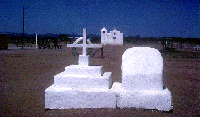
A chapel at the village of San Simon, in the western part of Tohono
O'odham Nation. Like all traditional O'odham Catholic chapels, the door
faces east. The two structures in the foreground are a cross and a niche
containing a saint's image. They serve as the focal point for the procession
that takes place on feast days. This sort of cross is often called the
"field cross."
The Tohono O'odham or Desert People were until the 1980s known as the
Papago Indians. However, they decided to abandon this name - it means
"Bean Eaters" - and return to the name they have always called
themselves. The Tohono O'odham live on the second largest reservation in the
United States, which stretches for over a hundred miles along the
Mexico/Arizona border and extends far into Southern Arizona. Traditionally,
they followed a unique agricultural system designed to take advantage of
heavy flooding that follows summer thundershowers in this desert country.
Few contemporary O'odham grow their traditional crops any more, however, and
most live in permanent villages watered by deep wells or in the cities
surrounding their reservation.
The O'odham language is still very much alive, as are many of the
traditional beliefs and attitudes that the early missionaries encountered.
Most O'odham have moved north across the border into the United States,
although a small remnant population still lives in Sonora. Most O'odham are
Catholics, having been exposed to missionary activities sing the late 17th
Century.
San Xavier Mission page
|